
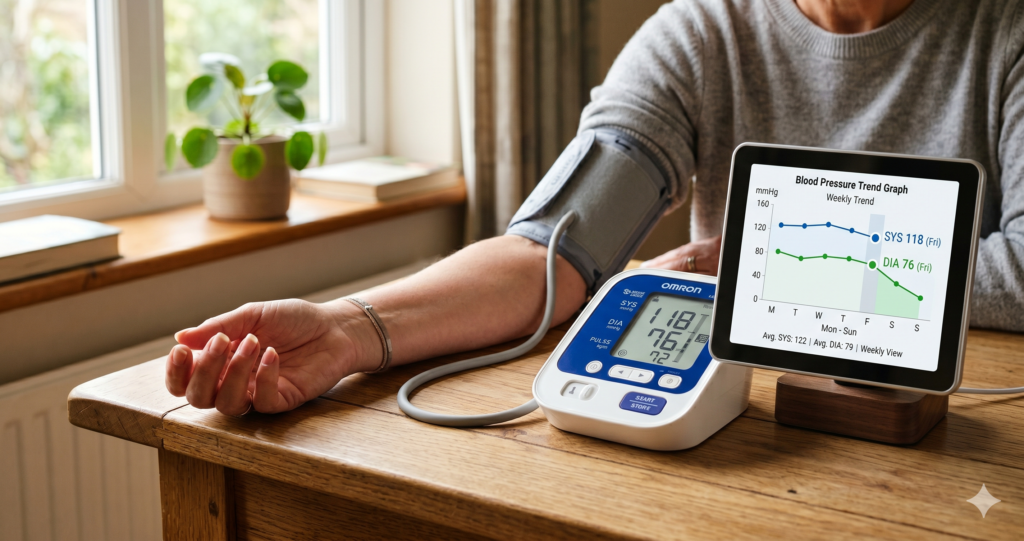
1 in 3 Indian adults has hypertension. Most don’t know it.
That statistic has been repeated so often it has almost lost its weight. But sit with it for a moment. One in three. If you are reading this with two other people in the room, one of you likely has blood pressure high enough to warrant treatment — and may have absolutely no idea.
Now here is the part that gets said less often: even among the people who do know they have hypertension, most are not doing regular blood pressure tracking at home — not consistently enough, not at the right times, and not in a way that lets anyone see the patterns that actually matter.
A single blood pressure reading is like a single frame from a three-hour film. It tells you what was happening at that precise moment. It tells you almost nothing about what is happening the rest of the time. And it is the rest of the time that determines your risk.
This article is about why trends matter more than readings, how to do blood pressure tracking at home correctly, and exactly what to bring to your next doctor’s appointment so they can finally see the full picture.
Why a Single Reading Can Mislead You — and Your Doctor
Every person who has ever been to a doctor’s clinic knows the ritual. You sit down, a cuff goes on your arm, a number appears. The doctor glances at it. If it is below 140/90, you are probably told you are fine. If it is above, concern follows.
This system has one significant problem: blood pressure is not a fixed number. It shifts constantly — across hours, across days, across seasons, and in response to everything from how well you slept last night to the traffic you sat in on the way to the clinic.
That last point has a name: white coat hypertension. This is a well-documented phenomenon where blood pressure rises in response to being in a medical setting — sometimes by as much as 20–30 mmHg. It affects up to 30% of patients. This means a significant number of people are being diagnosed with, or monitored for, hypertension based on readings that have nothing to do with their daily reality.
The reverse is also true — and more dangerous. Masked hypertension is where blood pressure appears normal in a clinic but is consistently elevated at home, during work stress, late at night, or in the early morning hours when cardiovascular risk is actually at its peak. Without home monitoring, masked hypertension goes entirely undetected. You leave the clinic reassured. The problem continues quietly.
The difference between a doctor who sees one clinic reading and a doctor who sees 30 home readings taken over four weeks is not a small one. One is making a decision based on a moment. The other is making a decision based on a pattern. The treatment, the medication choice, the urgency — all of it changes.
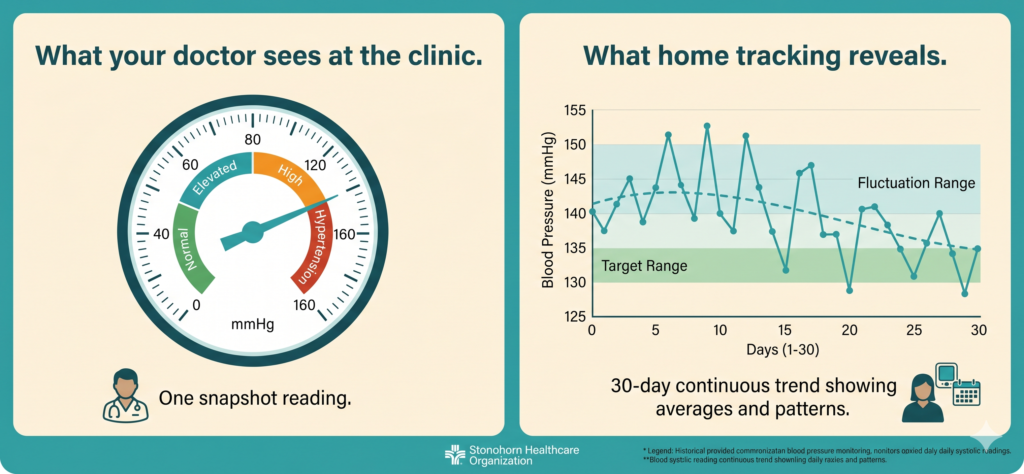
What Blood Pressure Tracking Trends Tell Doctors That Single Readings Never Can
When you bring a log of home readings to your doctor, you give them something genuinely useful — information they cannot get any other way, no matter how good they are.
Here is specifically what consistent blood pressure tracking reveals that a clinic reading never will:
Your true average. Medical guidelines increasingly recommend using the average of multiple home readings — typically taken over one to two weeks — as the basis for diagnosis and treatment decisions. This average is far more accurate, and far more honest, than any single clinic measurement.
Morning surge. Blood pressure rises sharply in the early morning hours, roughly between 6am and noon. This morning surge is linked to significantly elevated risk of heart attack and stroke — particularly in the first hours after waking. If your readings are consistently highest in the morning, your doctor needs to know. It changes which medication is prescribed and when it should be taken.
Whether your medication is actually working. If you are on blood pressure medication, blood pressure tracking at home is the only real way to see whether it is doing its job across the full day — not just at the moment of a clinic visit. Some medications work well in the morning and wear off by evening. Without a home log, this gap is completely invisible.
What is triggering your spikes. A log kept over several weeks often reveals patterns that even the patient had not noticed. Readings consistently higher on work days than weekends. Elevated numbers after poor sleep. A spike every time a stressful event occurs. These patterns, brought to a doctor, are genuinely clinically useful — and often personally eye-opening.
Understanding Your Numbers Before You Start Tracking
Before we talk about how to track, it helps to know what the numbers actually mean — in plain terms, without the clinical charts.
A blood pressure reading has two numbers. The top number (systolic) is the pressure in your arteries when your heart beats. The bottom number (diastolic) is the pressure when your heart rests between beats. Think of it as the difference between squeezing a water pipe and letting it rest.
Here is a simple way to understand the ranges:
| Category | Systolic | Diastolic | |
|---|---|---|---|
| Normal | Below 120 | and | Below 80 |
| Elevated | 120–129 | and | Below 80 |
| Stage 1 Hypertension | 130–139 | or | 80–89 |
| Stage 2 Hypertension | 140 or above | or | 90 or above |
| Hypertensive Crisis | Above 180 | and/or | Above 120 |
If you are diabetic or have kidney disease, your personal target may be lower than these general thresholds — ask your doctor what number they want you aiming for specifically.
One important thing to hold onto as you read this table: a single reading above 140/90 does not mean you have hypertension. A consistent pattern of readings above 140/90 — taken correctly, across multiple days — is what matters. One high reading on a stressful Tuesday is data. It is not a diagnosis.
How to Do Blood Pressure Tracking at Home Correctly
This is where most people quietly go wrong. Home blood pressure tracking sounds straightforward — you buy a monitor, you press a button, you write down a number. But small errors in technique can shift your reading by 10–20 mmHg in either direction. That is enough to change a normal reading to a concerning one, or to miss a real problem entirely.
Here is how to do it right:
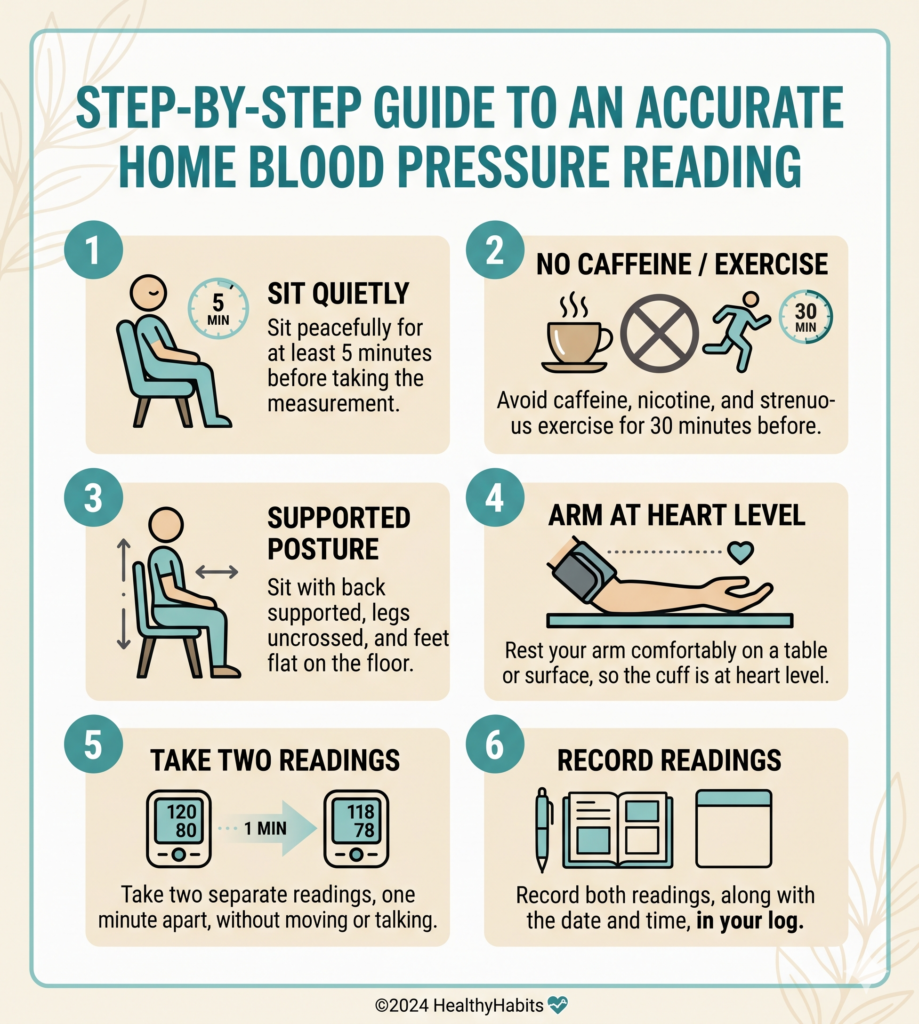
Sit quietly for at least five minutes before measuring. Even a brief walk from the kitchen to the bedroom temporarily raises blood pressure. The five-minute rest is not a suggestion — it is the step that makes your reading worth recording.
No chai, no cigarettes, no exercise for 30 minutes before. Even one cup of chai right before checking can push your reading up by enough to look like a problem that isn’t there. This is one of the most common reasons home readings seem inconsistent.
Sit properly — and this matters more than most people think. Back supported against a chair, feet flat on the floor and uncrossed, arm resting on a surface at heart level. A dangling arm gives a reading that is too high. A leg crossed at the knee does the same. It sounds fussy, but the numbers change meaningfully.
Use the same arm every time. There is usually a small but consistent difference between arms. Using the same one each time means your readings are actually comparable to each other.
Take two readings, one minute apart, and record both. The first reading is almost always slightly higher — your body is still adjusting. Record both and average them. Most doctors will want to see both values.
Measure at the same time each day. For blood pressure tracking to reveal meaningful trends, timing consistency matters as much as technique. Morning readings (before medication, before breakfast) and evening readings (before dinner) taken at the same time each day give you comparable, trustworthy data.
On equipment: Use a validated upper-arm automatic digital monitor. Wrist monitors are convenient but less reliable. Look for ISI certification or international validation on the packaging. Avoid finger monitors entirely — they are not accurate enough for health decisions.
How Often Should You Actually Be Checking?
Here is something worth saying honestly: most people who start blood pressure tracking at home make one of two mistakes. Either they check once a month and call it monitoring. Or — and this is far more common — they check five or six times a day, each reading feeding the next round of anxiety, the numbers climbing with every worried glance at the monitor.
Neither is useful. Consistent, scheduled monitoring is what produces reliable data. Reactive, anxious monitoring produces stress — which raises blood pressure — which produces more anxiety. It is a loop worth stepping out of.
If you have been diagnosed with hypertension: Measure twice daily (morning and evening) for the first two weeks after any change in medication or lifestyle. After that, once daily or at minimum four times a week, always at the same time.
If you are monitoring proactively — family history, borderline readings, or simply being sensible about your health after 40 — measure daily for one to two weeks to establish your baseline. Then once or twice a week, or before any medical appointment.
If your readings are consistently normal with no risk factors: A weekly check is enough to catch gradual changes before they become problems.
The goal of blood pressure tracking at home is not to catch every fluctuation. It is to build a picture over time that is accurate enough to act on.
What to Bring to Your Doctor — and What to Say
Most people do not bring home readings to their doctor appointments. Often it is because they assume the doctor will not have time to look at them, or because they feel slightly embarrassed that the log is incomplete, or simply because no one ever told them it was worth doing.
It is absolutely worth doing. A doctor who sees two weeks of your home readings will have a better conversation with you in ten minutes than one who has seen you for three years based only on clinic measurements.
Here is how to make that log as useful as possible:
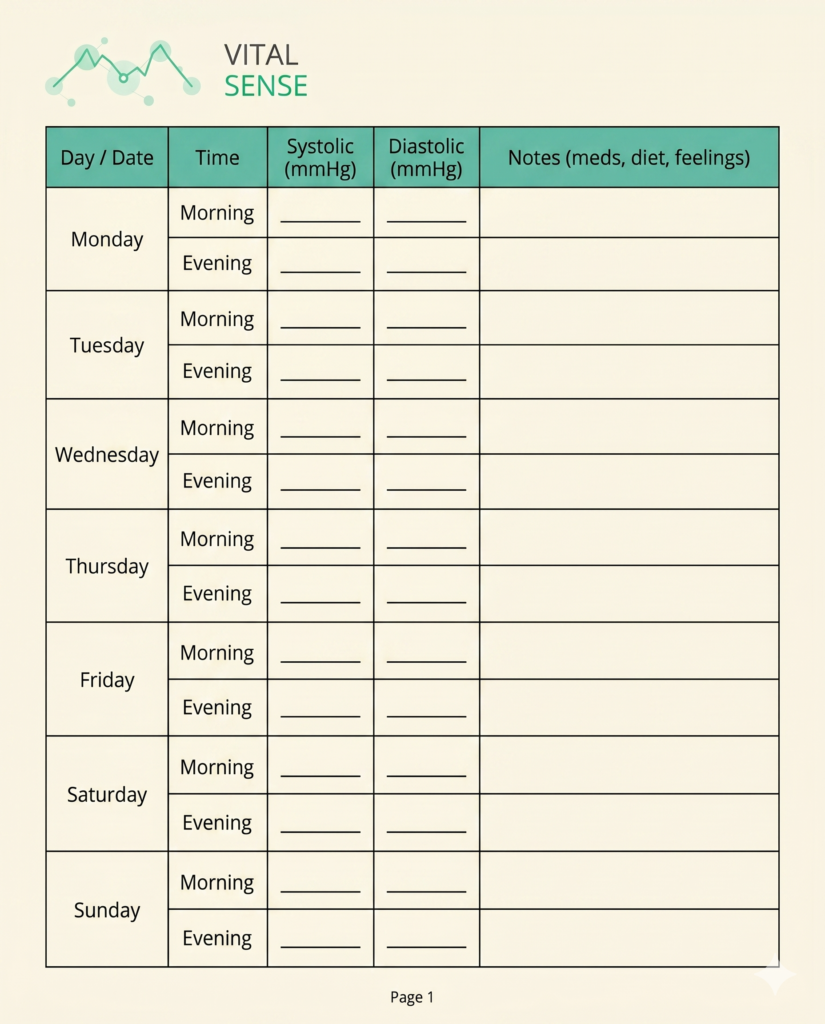
Bring at minimum two weeks of readings. One week gives your doctor a glimpse. Two weeks gives them something to work with. Four weeks gives them a genuinely reliable picture.
Add a notes column and actually use it. A spike on a day you were ill, under unusual stress, or had disrupted sleep tells a different story than a spike on an ordinary Tuesday. Context turns data into information.
Tell your doctor which arm you use and when you measure. These details help them assess the quality of your data — and some doctors will adjust their interpretation accordingly.
Ask about your morning readings specifically. If your morning readings are consistently higher than your evening ones, say so. Morning surge patterns affect both medication choice and timing.
If you are on BP medication, ask: “Am I taking this at the right time?” Some blood pressure medications are more effective when taken at night. The answer depends on your specific pattern — which your blood pressure tracking log will reveal, and which no clinic reading ever could.
Blood pressure tracking alongside your other health documents — prescriptions, blood reports, specialist notes — is what makes it genuinely useful over time. (If those records are currently scattered across your phone and a drawer somewhere, this guide on organising your health records is the practical starting point.)
The One Reading That Cannot Wait
While most elevated readings call for monitoring and a follow-up conversation, one scenario requires immediate action — not a wait-and-see approach.
If your blood pressure tracking shows a reading of 180/120 or above, go to the nearest emergency department the same day, even if you feel fine. If that reading comes with any of the following — severe headache, chest pain, shortness of breath, visual disturbances, confusion, numbness in the face or limbs — go immediately and call someone to take you. Do not drive yourself.
A reading this high without symptoms is called a hypertensive urgency. It still needs same-day medical attention. The word “urgency” is not accidental.
A Log Is a Story. Start Writing Yours.
Your blood pressure has a story. It rises and falls with your sleep, your stress, your meals, your movement, and the particular rhythms of your life that no clinic visit will ever capture.
Consistent blood pressure tracking at home is not about becoming obsessed with numbers. It is about building, over weeks and months, a picture that is accurate enough for real decisions — about medication, about lifestyle, about risk.
The people who manage hypertension well are not always the ones with the best doctors or the most advanced hospitals. They are the ones who showed up to their appointments with two weeks of home readings, a notes column, and a willingness to have a real conversation about what the pattern means.
Start this week. Take one reading tomorrow morning — before chai, before the day begins. Write it down. That is the first line of a story that could, in time, matter more than you expect.
Download the Free Blood Pressure Tracking Log
A printable two-week blood pressure tracking template — designed for Indian patients. Morning and evening columns, a notes section, and a simple weekly average calculator. Take it to your next appointment and let the data do the talking.