
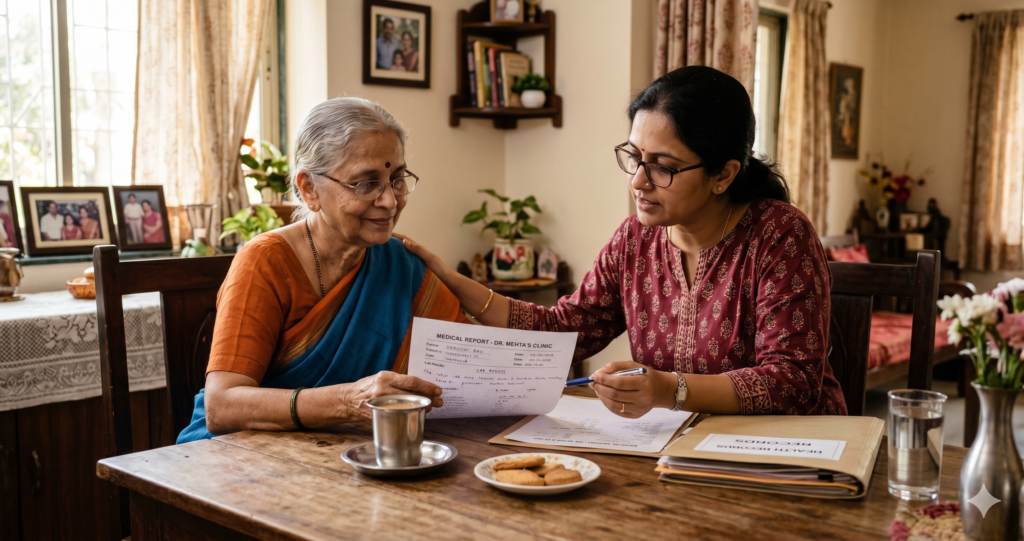
If you’re reading this, chances are you are the person in your family who remembers which hospital your father had his bypass at, which medicines your mother takes every morning, and which doctor said what three years ago. That means you unknowingly manage your parents health records
You are the one who gets the call when something goes wrong. You are the one who sits in the waiting room, filling out forms from memory. You are the one who, at 11pm on a Tuesday, is scrolling through old WhatsApp messages trying to find a prescription photo someone forwarded six months ago.
You are the family’s unofficial health manager. And no one gave you a manual.
This article is that manual.
The Invisible Labour Nobody Talks About
There is a particular kind of exhaustion that comes with managing an ageing parent’s health. It is not the exhaustion of lifting or nursing — it is the mental exhaustion of holding everything in your head.
Which cardiologist did Papa see last? Was it Fortis or Medanta? What was his creatinine level in March? Does Maa have a penicillin allergy or was that just a reaction that one time? When is the next endocrinology follow-up?
This constant background processing — the invisible labour of caregiving — falls disproportionately on one person in the family. Often it is the child who lives closest, or the one who seems most “organised,” or simply the one who picked up the phone first. It is rarely a chosen role. It becomes yours by default.
And it is important. Far more important than most people realise.
When a parent sees a new specialist, the quality of care they receive depends enormously on the history they bring with them. A cardiologist who knows your father’s complete medication list, previous ECG results, and kidney function history can make decisions in 20 minutes that would otherwise take three appointments. That history — the ability to provide it quickly, accurately, and completely — is what you carry.
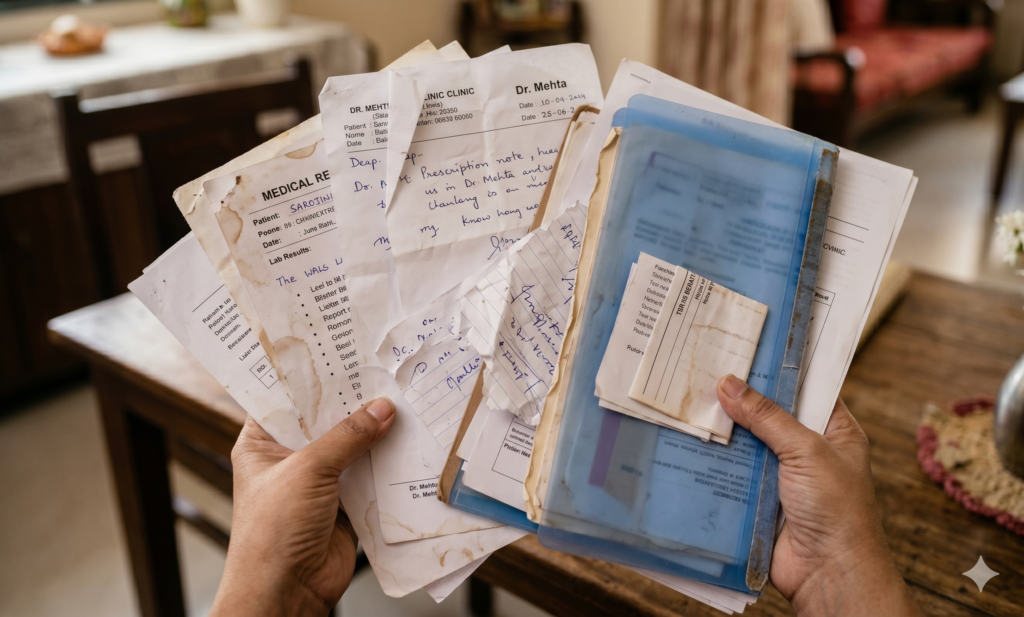
The problem is that most caregivers carry it entirely in their heads, or scattered across devices, paper files, and half-remembered conversations. That is not a sustainable or safe way to manage your parents health records which is something this important.
When Missing Parents Health Records Cause Real Harm
The consequences of scattered health records are not abstract. They play out in consulting rooms and emergency wards every day.
At the specialist’s office: Your mother is seeing a new nephrologist for the first time. He asks for her previous kidney function tests. You have her most recent one on your phone — photographed last month — but the baseline from two years ago, which would show whether her creatinine has been rising or is stable, is in a file at your parents’ home. The specialist makes his assessment without the trend data. He cannot tell if this is a chronic problem getting worse or a stable condition that simply needs monitoring.
At the pharmacy: Your father is prescribed a new blood pressure medication. The pharmacist asks if he is on any other medicines. You rattle off three names you remember — but you are not sure of the exact dosages, and you have forgotten about the cholesterol tablet his physician in Lucknow added eighteen months ago. A drug interaction goes unchecked.
In an emergency: Your mother is rushed to a hospital your family has never visited before. She cannot speak clearly. The admitting doctor asks if she has any known allergies. You believe she doesn’t — but you’re not entirely certain. You think about the time she had a reaction to something, years ago. Was it a medicine or a food? You cannot remember.
These are not worst-case scenarios. They are Tuesday afternoons in the lives of families all over India. (If this sounds familiar, here is why health records become so scattered in the first place — and what it costs.)
Building a Family Health Profile: Step by Step
The goal is not to create a perfect archive overnight. It is to build something useful, accurate, and accessible — starting this weekend, with what you already have.
Here is how to approach it.
Step 1: Create one profile per parent
Treat each parent as a separate profile (parents health records). Do not mix their records. Label everything clearly with the parent’s name and the date.
For each parents health records, you need four things to start:
The medicine list. Write down every medicine they take, including over-the-counter supplements and herbal remedies. For each one, note the name, dosage (e.g., 500mg), frequency (e.g., twice daily after meals), and which doctor prescribed it. This single document is the most important thing you can create today.
The doctor list. Names, specialisations, hospital affiliations, and contact numbers for every doctor your parent currently sees or has seen in the last three years. Include the ABHA number or patient ID if the hospital has issued one.
The conditions list. A simple, plain-language summary of their known diagnoses. Hypertension, Type 2 diabetes, hypothyroidism — whatever applies. Include the approximate year of diagnosis if you know it.
The allergy and reaction list. Any known drug allergies, food allergies, or adverse reactions to medication. If you are unsure, write “unknown — to be confirmed” rather than leaving it blank.
Step 2: Gather the key documents
Once you have the profile basics in place, start collecting the most critical documents. You do not need everything — focus on what is most likely to be needed.
In order of priority:
- Most recent complete blood panel (within the last 12 months) — (understanding what those numbers mean is a good companion to this step)
- Most recent ECG or cardiac report (if applicable)
- Most recent kidney function test (especially important for diabetic parents)
- Any discharge summaries from hospitalisations in the last five years
- Reports from specialist consultations in the last three years
- Vaccination records (especially influenza and pneumococcal for elderly parents)
Do not wait for perfection. A partial file today is worth far more than a complete file you never create.
Step 3: Pick one location — and stick to it
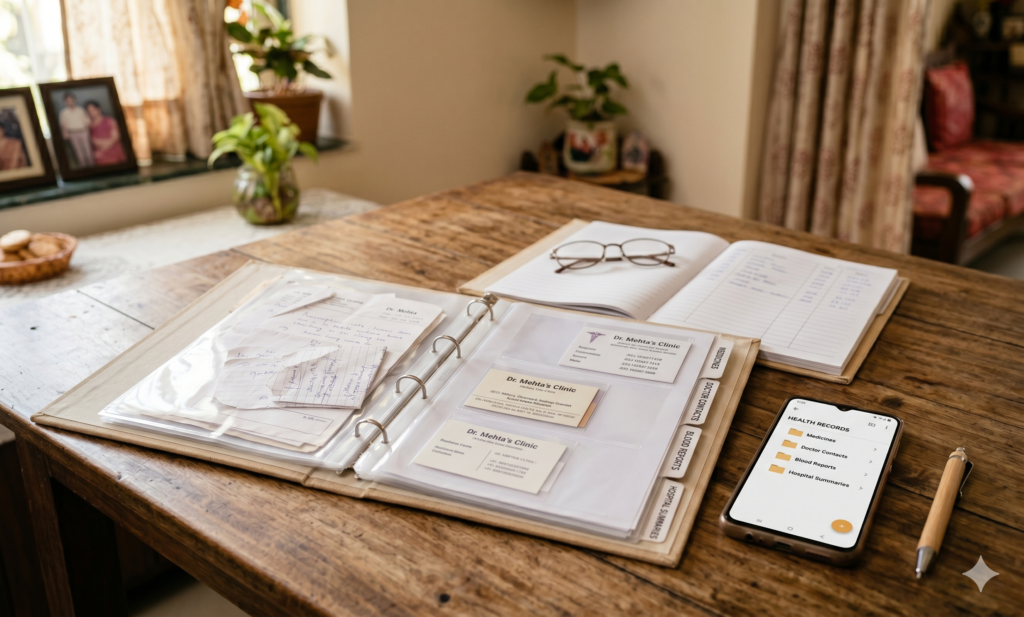
The most common reason parents health records remain scattered is the absence of a single designated place. Decide now: one folder, one app, one location. Tell at least one other family member where it is and how to access it.
For physical documents, a labelled accordion file or a simple three-ring binder with dividers works well. Keep the most recent reports at the front.
For digital copies for your parents health records, a dedicated folder in Google Drive or your phone’s cloud storage — shared with at least one other trusted family member — ensures that the records are accessible even when you are not physically present.
Whatever you choose: one place. Not two. Not “I’ll remember.”
Step 4: Update it after every significant appointment
A health profile is only as useful as it is current. After every specialist visit, hospitalisation, or change in medication, spend five minutes updating the relevant section. Add the new report. Update the medicine list if anything changed. Note what the doctor said in a one-line summary.
Five minutes after each appointment prevents three hours of frantic searching during the next one.
Sharing Parents Health Records With Multiple Doctors
Managing parents health records who see multiple specialists — a common reality for anyone with diabetes, hypertension, or cardiac conditions — means ensuring that each doctor has the relevant context from the others.
Doctors in India, especially across different hospital systems, rarely share records with each other. The patient and their family are the connective tissue of the healthcare system. You are, in practice, the care coordinator.
A few things that help:
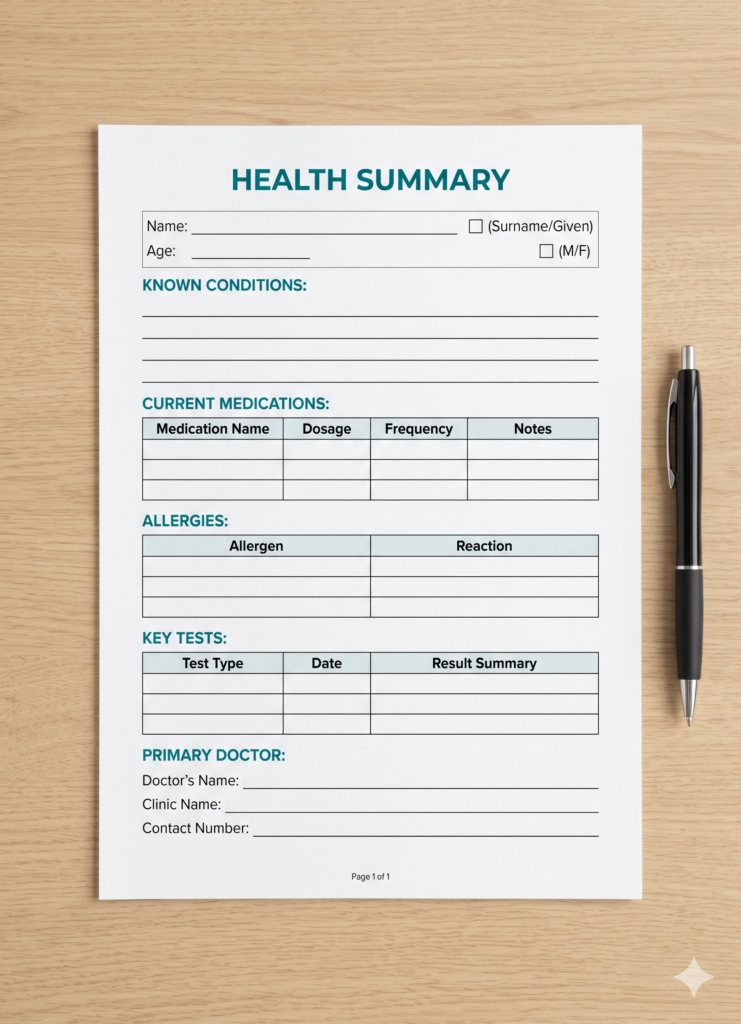
Carry a one-page summary to every appointment. This does not need to be elaborate. Name, age, conditions, current medicines (with dosages), known allergies, recent significant tests. One A4 sheet. Doctors appreciate it enormously — it allows them to focus on the current problem rather than reconstructing history.
Always ask for a copy of whatever is generated. After every consultation, every test, every hospital stay — ask for a copy of the report, the prescription, or the discharge summary before you leave. It is your right to have it, and it is far easier to collect in the moment than to chase later.
Flag interactions proactively. When a new medicine is prescribed, mention all existing medicines — including supplements — to the prescribing doctor. Do not assume they have the full list. Even if they do, confirming it takes 30 seconds and can prevent a serious interaction.
Use the word “previous.” “Do you want to see his previous kidney function reports?” is a sentence that changes the quality of a specialist consultation. Most doctors will say yes, and the ones who don’t will at least be aware that the history exists.
A Note for You, the Caregiver
This section is not about managing parents health records. It is about you.
Managing your parents’ health while also managing your own life — your job, your children, your own health — is not a small thing. It is a sustained, invisible effort that rarely gets acknowledged. The phone calls you take at work. The appointments you rearrange your week around. The anxiety you carry between diagnoses and follow-ups.
It is worth saying plainly: what you are doing matters, and it is hard, and you are allowed to find it hard.
A few things that help caregivers sustain this role over the long term:
Share the load explicitly. If you have siblings, assign specific responsibilities rather than assuming you will all pitch in vaguely. One person manages appointments. One person manages the medicine stock. One person handles insurance claims. Explicit roles reduce the invisible-load problem significantly.
Keep a copy of the parents health records accessible to at least one other family member. If something happens to you — if you are unreachable, unwell, or travelling — someone else needs to be able to step in. This is not pessimistic planning. It is responsible caregiving.
Schedule your own health check-up. Caregivers, particularly those managing a parent through a chronic illness, are significantly more likely to neglect their own health. If you cannot remember the last time you had a blood panel done, that is your sign. (And when you do go — here is how to make sense of the results.)
Know that organised parents health records are an act of love. Every time you spend twenty minutes updating a health file, you are doing something that could matter enormously — at a follow-up, at an emergency, at a moment when the right information saves time and possibly more. You will not always see the impact. But it is there.
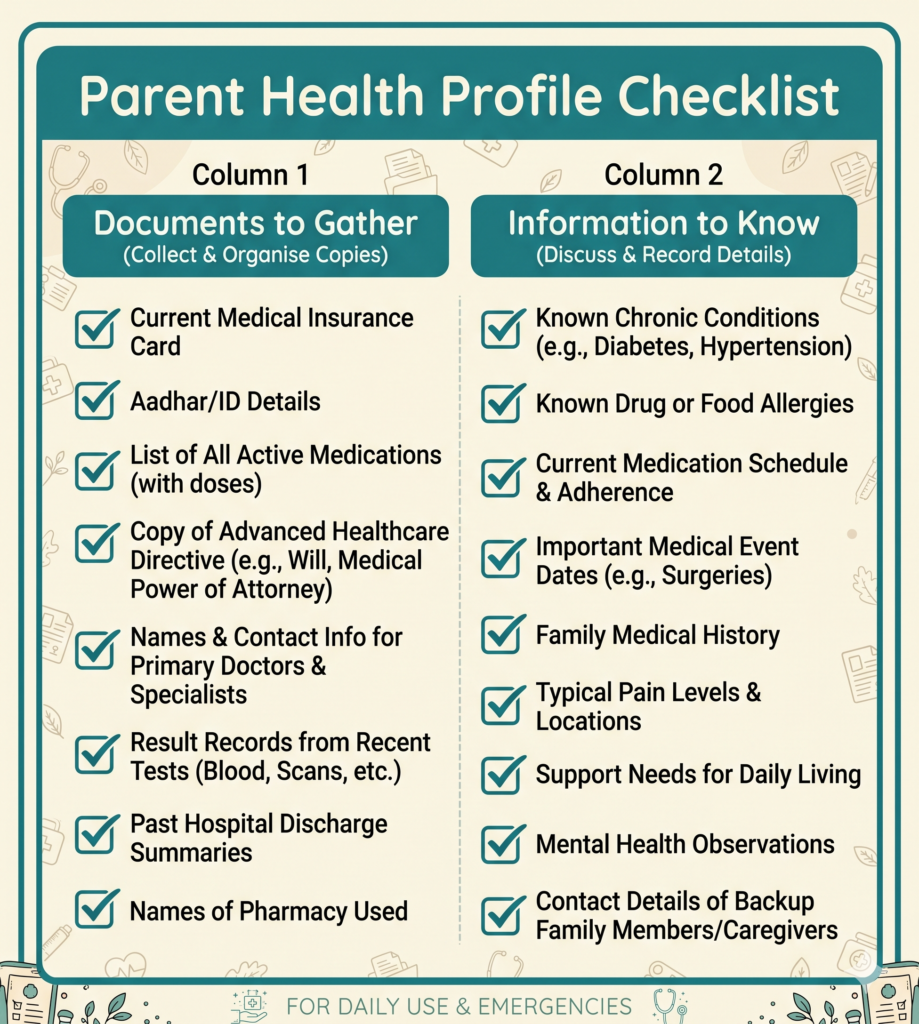
The Checklist: What a Complete Parent Health Profile Looks Like
Information to know (no documents needed):
- Full name, date of birth, blood group
- All current medicines — name, dosage, frequency
- All known diagnoses — with approximate year
- All known allergies or drug reactions
- Name and contact of primary doctor
- Name and contact of each specialist they see
- Insurance provider and policy number
- ABHA / Ayushman Bharat number (if applicable)
Documents to collect and file:
- Most recent complete blood report
- Most recent ECG (if cardiac history exists)
- Most recent kidney function test
- Most recent HbA1c (if diabetic)
- Discharge summary from last hospitalisation
- Reports from specialist consultations (last 3 years)
- List of vaccination history
- Any imaging reports (X-ray, echo, MRI) from the last 5 years
Readiness test:
- Can another family member access this profile without calling you?
- Could you produce a one-page health summary for a new doctor in under 10 minutes?
- Is the medicine list current as of this month?
Start with Ten Minutes
You do not need to build a complete health archive today. You need to start.
Open a notes app right now. Write down your parent’s full medicine list — everything you can remember. That is your first document. That is the beginning of the profile that could matter enormously at 2am in an emergency room, or at a routine cardiology appointment next Tuesday.
The families who navigate their parents’ healthcare most effectively are not the ones with the most resources. They are the ones with the clearest information, available at the right moment.
You already know most of what needs to be written down. The only step left is writing it down.
Download the Free Family Health Records Starter Kit
A ready-to-fill template to build a complete health profile for each parent — medicine list, doctor contacts, key documents checklist, and a one-page appointment summary. Print it, fill it in, and share it with the family.
No spam. Just one thing that could matter when it counts.