
Imagine this.
It’s 2am. You’re in the emergency room of a hospital you’ve never visited before. The attending doctor turns to you and asks three questions related to health data:
“What medications is she on?”
“Does she have any allergies?”
“When was her last ECG?”
You’re looking at your mother. She can’t answer. And as you reach for your phone to scroll through old WhatsApp messages, hoping to find a photo of a prescription from eight months ago — you realize you don’t actually know.
This is not a rare scenario. It happens in hospitals across India every single day. And it’s not a failure of love or attention. It’s a failure of preparation — one that most Indian families have never been guided through.
This article is that guide.
The Health Data Readiness Test: 10 Questions
Before we get into what readiness looks like, take this quick test. Answer honestly — yes or no.
- Can you name the last three medicines a family member over 50 in your household takes — right now, without looking?
- Do you have your most recent blood test report accessible on your phone or computer within 2 minutes?
- Do you know if anyone in your immediate family has a documented allergy to any medication or food?
- If a new specialist asked for your health history today, could you summarise it in under 5 minutes?
- Do you know your own blood group — and your parents’ blood groups?
- Can you name the hospitals or clinics where each member of your family has received major treatment in the last 5 years?
- Do you have a record (digital or physical) of vaccinations received by the children or elderly in your household?
- Do you know your most recent blood pressure and blood sugar readings — even approximately?
- Is there one place — a folder, file, or app — where your family’s key health documents are stored together?
- If you had to hand over health management responsibility to a sibling or spouse tomorrow, could you explain everything they’d need to know?
Your Score
8–10 Yes: You’re already health data ready. You’re in a small minority — and your family is safer for it.
5–7 Yes: You have the instinct, but the system is incomplete. A few gaps could matter in a crisis.
0–4 Yes: You’re in the majority of Indian households. This isn’t a judgement — it’s an invitation to change something that genuinely matters.
Why Most Indians Score Low — And Why It’s Not Their Fault
India’s healthcare system was not designed around the patient. It was designed around the doctor, the hospital, the prescription pad.
Records live in paper files distributed across clinics and hospitals. Doctors don’t share reports between themselves. Patients are rarely told to keep a personal health history. And the idea of centralised, accessible family health data has simply never been part of how we manage our health.
So when a family member ends up in an emergency — or when you’re sitting in a new specialist’s waiting room, filling out a form that asks for “previous diagnoses and treatments” — the gap becomes painfully visible.
The result? Repeated blood tests because no one can find the last one. Doctors making decisions without full histories. Families scrambling through WhatsApp photo albums at midnight. Caregivers carrying years of medical context entirely in their heads, with no backup.
It’s not laziness. It’s a system that was never built to support you.
What Health Data Readiness Actually Looks Like
You don’t need a sophisticated app or a filing cabinet. You need one reliable place — digital or physical — where the right information lives, and a basic habit of keeping it updated.
Here’s what that looks like in practice:
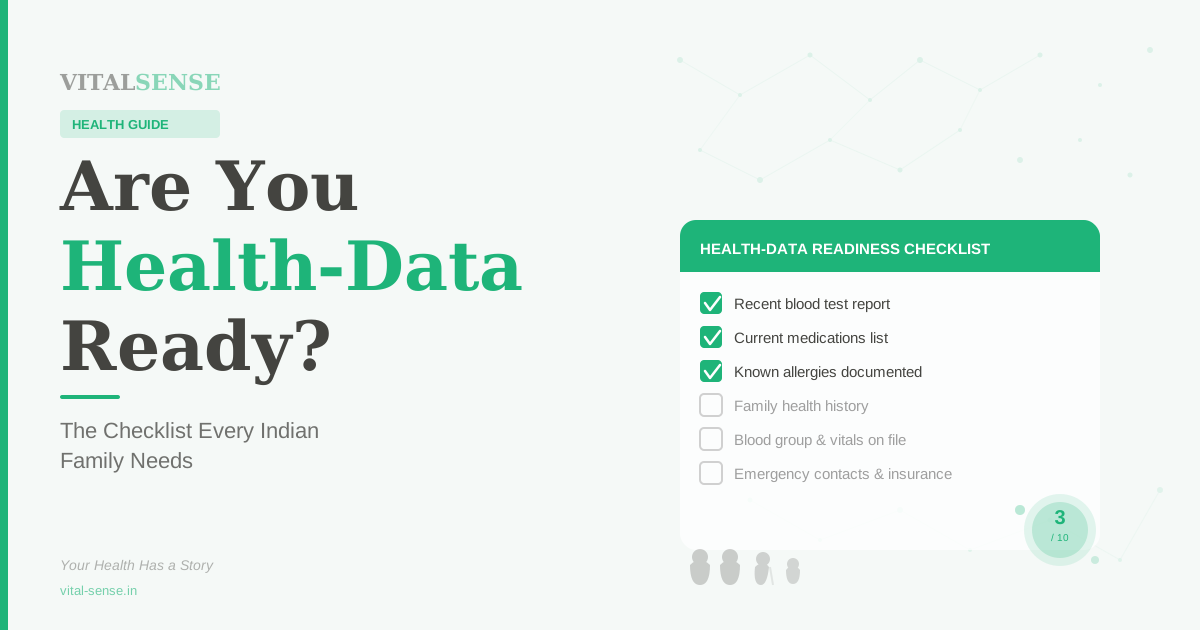
For yourself: A folder (on your phone, laptop, or in a physical file) that contains your most recent blood test, a note of your chronic conditions or diagnoses, a list of current medications with doses, your blood group, and the contact details of your primary doctor.
For an elderly parent: The same, plus their vaccination records, a list of specialists they see and why, their insurance details, and any surgical or hospitalisation history with dates.
For a child: Vaccination card (digital copy), any diagnosed conditions or allergies, school health records, and a note of which paediatrician they see.
The goal isn’t perfection. It’s accessibility. The right information, findable in under five minutes, by the right person, at the right moment.
The Essential Documents Checklist
These are the documents every Indian household should have stored and accessible. Work through this list one family member at a time.
Medical History
- List of current diagnoses (e.g., hypertension, diabetes, thyroid disorder)
- History of major illnesses, surgeries, or hospitalisations — with approximate dates
- Known allergies — medications, food, materials
- Family history of significant conditions (heart disease, cancer, diabetes)
Medications
- Current prescription list — medicine name, dose, frequency
- Over-the-counter supplements or vitamins taken regularly
- Most recent prescription (even a photo is useful)
Recent Test Reports
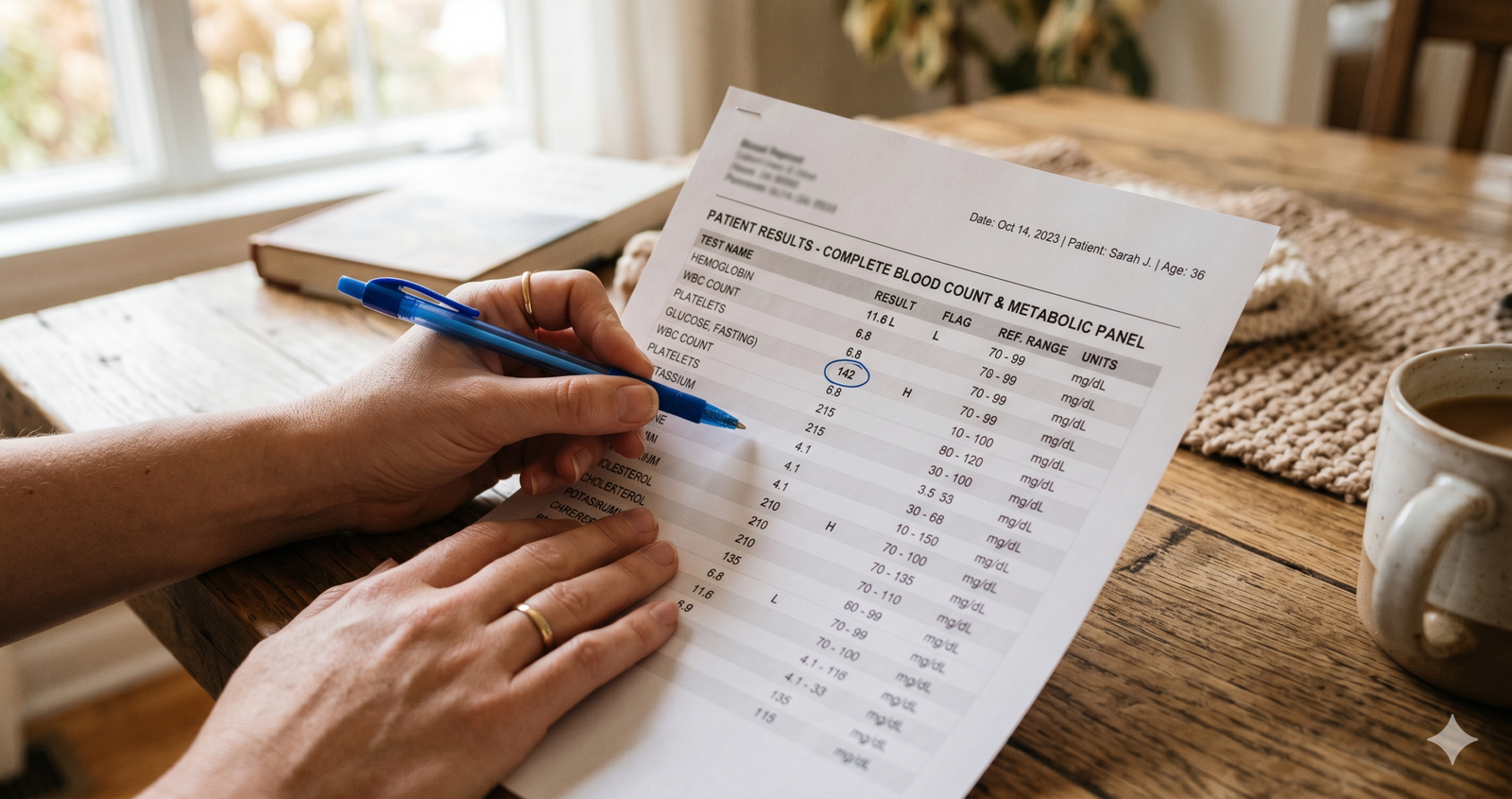
- Most recent CBC (complete blood count)
- Most recent lipid profile
- Blood sugar / HbA1c (especially for anyone over 35 or with family history of diabetes)
- Thyroid function test (TSH), if relevant
- Most recent ECG or echocardiogram (for anyone over 45 or with cardiac history)
- Any specialist reports from the last 2 years
Vitals — Track and Know
- Blood group
- Most recent blood pressure reading (with date)
- Most recent fasting blood sugar (with date)
- Height and weight (for BMI reference)
Administrative
- Health insurance policy number and emergency helpline
- ABHA health ID (if registered)
- Contact details of primary doctor, cardiologist, or any regular specialist
Next Steps — By Family Type
Everyone’s starting point is different. Here’s where to begin based on your situation:
If you’re managing your own health
Start with a single digital folder — on Google Drive, your phone gallery, or your email drafts if nothing else. Label it “My Health Records.” Add your last blood test, your current prescriptions, and a one-paragraph note about any conditions or diagnoses. That’s it for today. You can build from there.
If you’re managing a parent’s health
The hardest part is often the first conversation. Ask your parent to walk you through their conditions and medicines — don’t assume you already know. Document it. Create a separate folder for each parent. The investment is an hour now, and it pays off in every hospital visit that follows.
If you’re a young adult with no major health issues
Now is the easiest time to build the habit. Your record is short. Create a folder, add your blood group, your last annual checkup if you’ve had one, and any childhood medical history you know about. The people who are most health data ready in a crisis are usually the ones who started before they needed to be.
If you have a chronic condition (diabetes, hypertension, thyroid)
Your record needs more frequent updating. Prioritise trend data — not just a single reading, but a log of readings over time. Your doctor needs to see patterns, not snapshots. A simple spreadsheet or even a notes app works. The goal is that every appointment, you arrive with context — not just a vague sense of “I think it’s been okay.”
A Small Action, A Significant Shift
You don’t have to transform your entire approach to health data management today. You just have to take one step.
Find one report. Save it somewhere you’ll actually look. Write down three things you know about your own health — your blood group, one condition, one medication. Tell one family member where that information lives.
That’s health data readiness in its simplest form. And it matters more than most of us realize — until the moment it really does.
Want the complete checklist as a printable PDF?
We’ve put together a one-page health data readiness guide — covering all the documents, vitals, and steps above — that you can fill in for each family member and keep on hand.
Enter your email below and we’ll send it to you.