
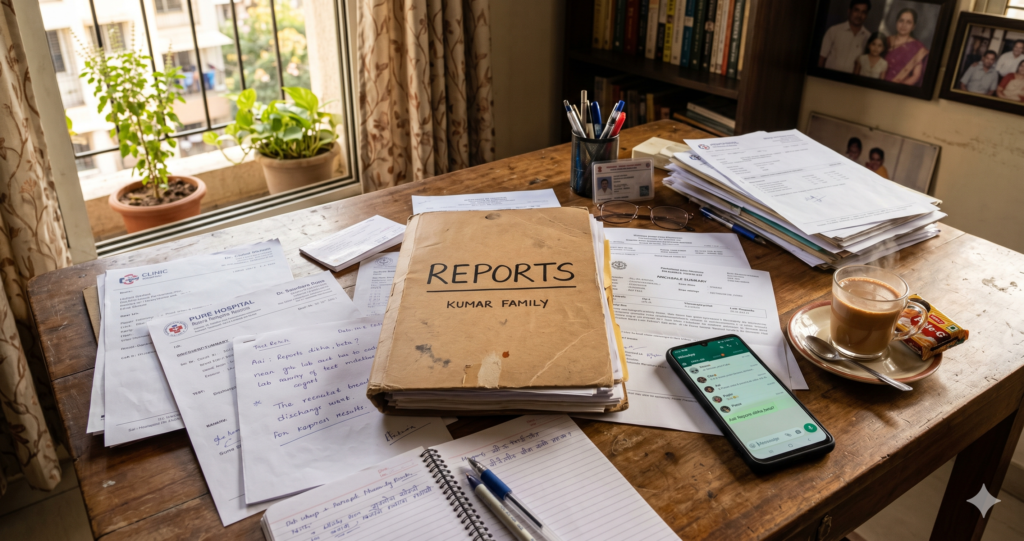
Last Tuesday, Meera spent 45 minutes searching for her father’s echocardiogram before a cardiology appointment. She never found these medical records.
The cardiologist did what he could. He ordered a fresh ECG, repeated some blood work, and asked the family to come back with whatever they could locate. Meera’s father — 68 years old and visibly exhausted — sat through tests he had already done eight months earlier. Not because his health demanded it, but because no one could find where the old medical records had gone.
This story is not unusual. In fact, it is remarkably ordinary.
Across India, in homes in Mumbai and Madurai, Lucknow and Ludhiana, some version of this scene plays out every single day. Medical records that matter — test results, discharge summaries, doctor’s notes, specialist reports — are scattered across drawers, phones, email inboxes, and half-remembered conversations. Not because families do not care. But because no one ever gave them a better way.
This article is about why that happens, what it quietly costs you, and what doing things differently actually looks like.
Why Medical Records Become Scattered in the First Place
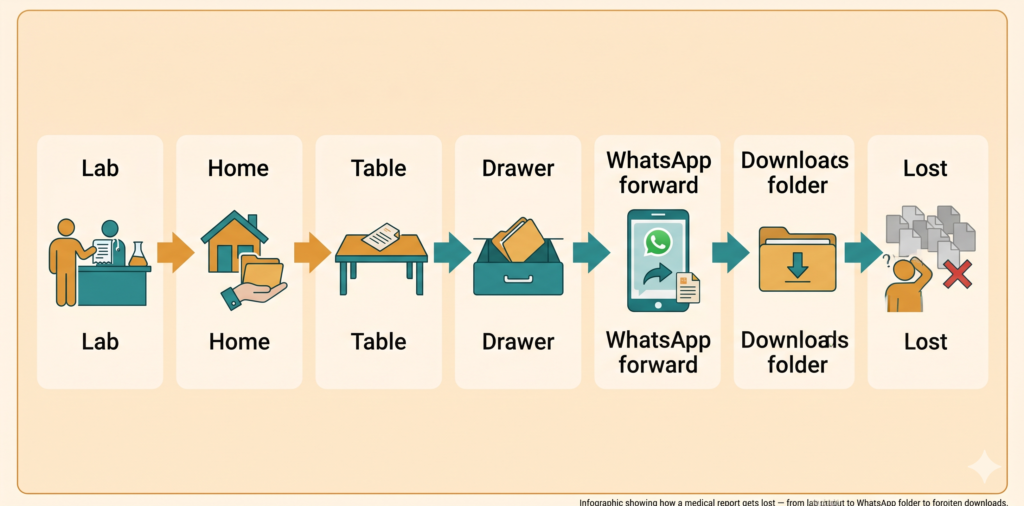
To understand the problem, trace the life of a single document — say, a routine blood report.
It begins as a printed sheet, collected from a lab counter or hospital reception. It comes home in a bag or folder. Someone places it on the dining table, fully intending to “file it properly later.” But later is always busy. These medical records migrates — to a drawer, to a pile, to a cardboard box in the bedroom almirah.
Sometimes it gets photographed: a blurry shot taken at midnight, saved between food photos and bank screenshots. Sometimes it gets forwarded to the family WhatsApp group — buried under 200 good morning messages within a week. Sometimes it gets scanned and emailed to no one in particular. And sometimes, it simply disappears into the layers of daily life.
Now multiply this by every hospital visit, every specialist consultation, every diagnostic lab, and every pharmacy prescription across a decade. A family managing the health of one elderly parent could easily accumulate hundreds of documents across multiple cities, two or three hospitals, and several devices — with no single person holding a complete picture.
There is also the fragmentation problem. India’s healthcare system, particularly for middle-class families, typically involves multiple providers: a neighbourhood family doctor, a specialist at a private hospital, a government facility for routine checkups, and a diagnostic chain for lab work. Each generates records in its own format, on its own letterhead, stored in its own system. None of these providers talk to each other. The burden of connecting these dots falls entirely on the patient — and their family.
This is the origin of the scattered health record or medical records. It is not laziness. It is the absence of a system designed for how real Indian families actually live. External link
The Real Cost: More Than Just Inconvenience
Most people treat scattered health records as a minor annoyance — something to sort out “someday.” But the cost is far higher than it appears, and it shows up in four concrete ways.
Repeated tests and wasted money
When a new doctor cannot access your previous medical records, they will often order the same investigations again. A CBC, a lipid panel, a thyroid profile — tests that cost anywhere from ₹500 to ₹5,000 — get repeated simply because the old results cannot be found or verified. For families managing a chronic illness like diabetes or hypertension, this can mean thousands of rupees spent annually on redundant diagnostics.
Delayed diagnoses
A single report rarely tells the full story. A pattern of rising blood sugar over three years tells a far more important story than one reading taken in isolation. When records are scattered across time and place, the pattern becomes invisible — even to a skilled doctor. Conditions that could have been caught early, managed conservatively, or even reversed are identified only when they have progressed.
Rushed, incomplete consultations
When you walk into a specialist’s room without your health history, the doctor spends the first ten minutes reconstructing a picture from fragments. You try to remember which hospital, which year, which medication. The consultation that was supposed to be about your current condition becomes a reconstruction exercise. The doctor makes decisions with incomplete information. You leave with instructions that may not account for your full health context.
Crisis moments without answers
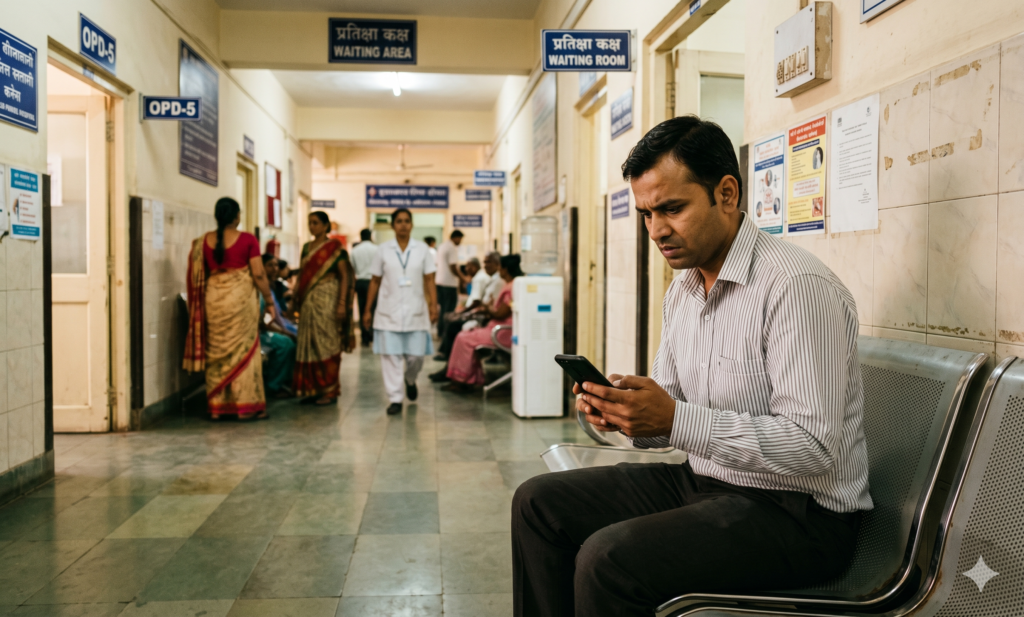
This is the cost that matters most. In an emergency — a sudden cardiac event, a severe allergic reaction, a fall, a stroke — the doctors treating your family member need immediate answers. What medications is he on? Does she have any known allergies? When was his last ECG? Has she had surgery before? If the person who holds this information is not in the room, or cannot remember, or cannot reach their phone, the consequences can be serious.
What Organized Medical Records Actually Look Like
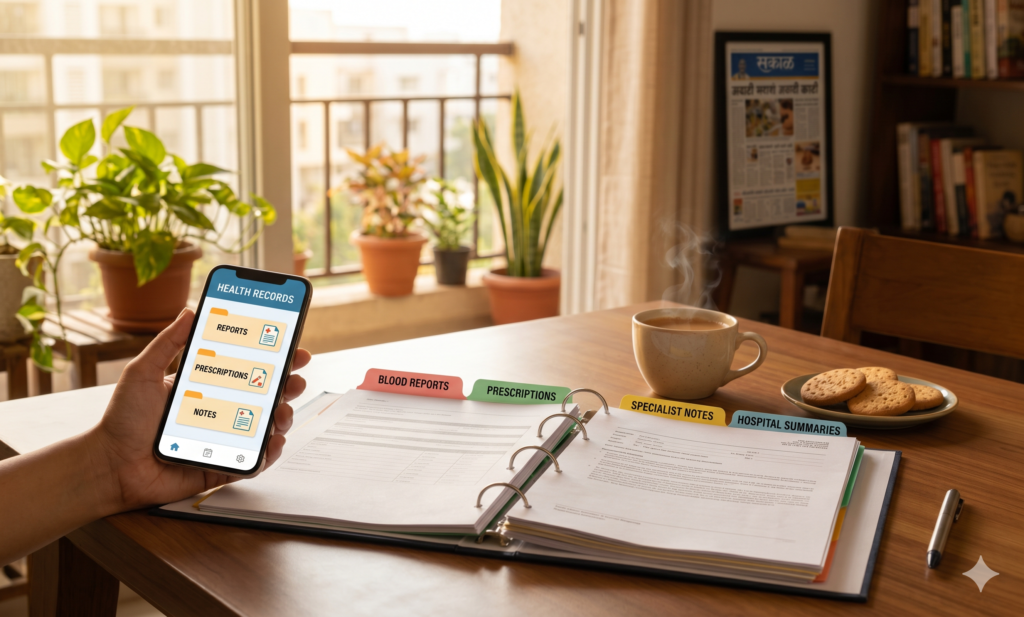
The goal is not perfection. You do not need colour-coded binders or a filing cabinet with labelled tabs (though those work too). What you need is a system that answers three questions quickly: What do I have? Where is it? Can I share it in five minutes?
For most families, this means creating one reliable location — physical, digital, or both — where all health documents for each family member live. Not scattered across devices, but in one place that everyone with a need to know can access.
A well-organised health record for one person typically includes:
- Their most recent complete blood report (within the last 12 months)
- Any specialist reports or diagnoses from the past five years
- Current prescriptions and medication list with dosages
- Discharge summaries from any hospitalisations
- Vaccination records
- A list of known allergies or adverse drug reactions
- Key vital trends — blood pressure, blood sugar, weight — tracked over time
This does not need to be digitised overnight. Start with one person. Start with the most recent six months. Build the habit before you build the archive.
Your Medical Records Checklist: Start Today
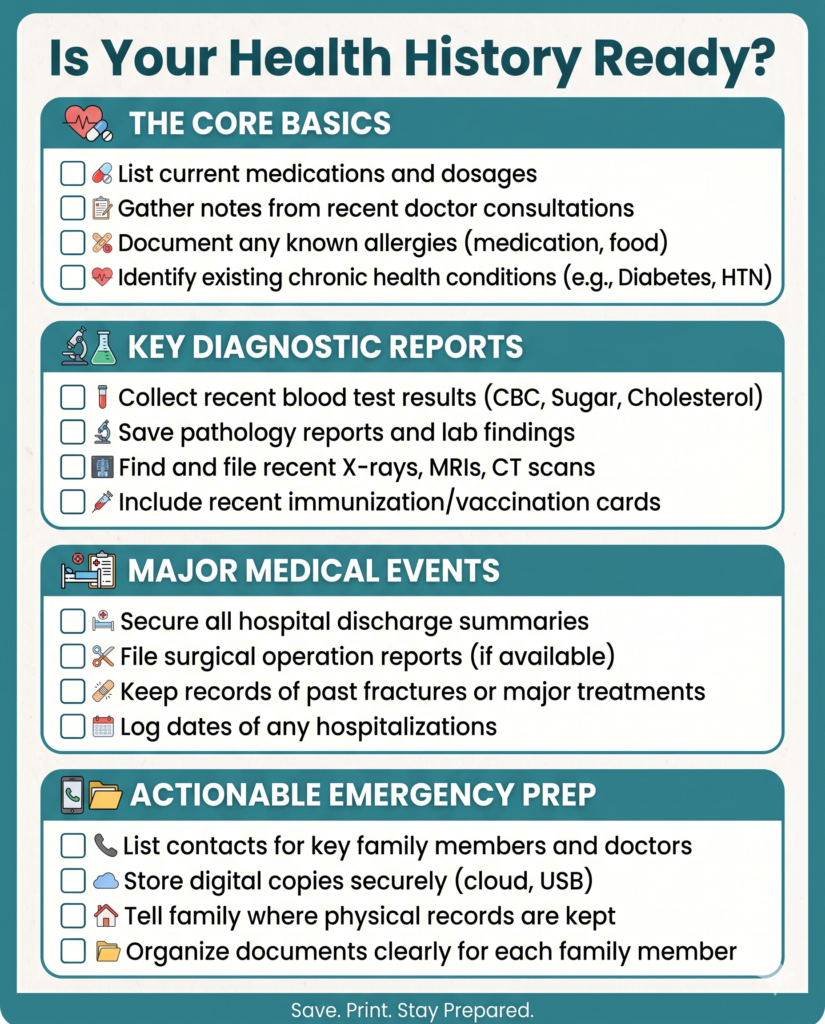
If you checked fewer than half of these boxes, your health history is more vulnerable than you might realise. That is not a criticism — it is the situation most Indian families are in. The good news is that it can be changed, one document at a time.
The Best Time to Organise Is Before You Need It
Meera eventually found her father’s echocardiogram — three weeks after that appointment, inside a plastic bag in her wardrobe, folded inside a utility bill from 2021. By then, the follow-up had already happened without it.
The goal of organising your medical records is not to prepare for the worst. It is to make sure that when your family needs healthcare — whether it is a routine check-up or something far more urgent — the information that could help them is actually available.
That is what good health management looks like. Not complicated. Not expensive. Just ready.
Pingback: How to Easily Read Your Blood Test Report In 2 mins: A Plain-Language Guide - Vital Sense
Pingback: Managing Your Parents Health Records: A Practical Guide for Busy Caregivers - Vital Sense
Pingback: 5 Trends Your Blood Pressure Tracking Are Telling You (That Your Doctor Can't See) - Vital Sense